




 login
login








Battery Cell Benchmarking Report

We offer for sale battery cell benchmarking reports prepared by FEV.
FEV possesses extensive expertise in battery cells and advanced testing capabilities.
The company operates testing laboratories in Aachen, Paris, Munich, and Coventry, equipped with facilities capable of conducting electrical tests, safety tests, durability tests, and abuse tests. FEV also has deep expertise in cell assembly, disassembly, and benchmarking.
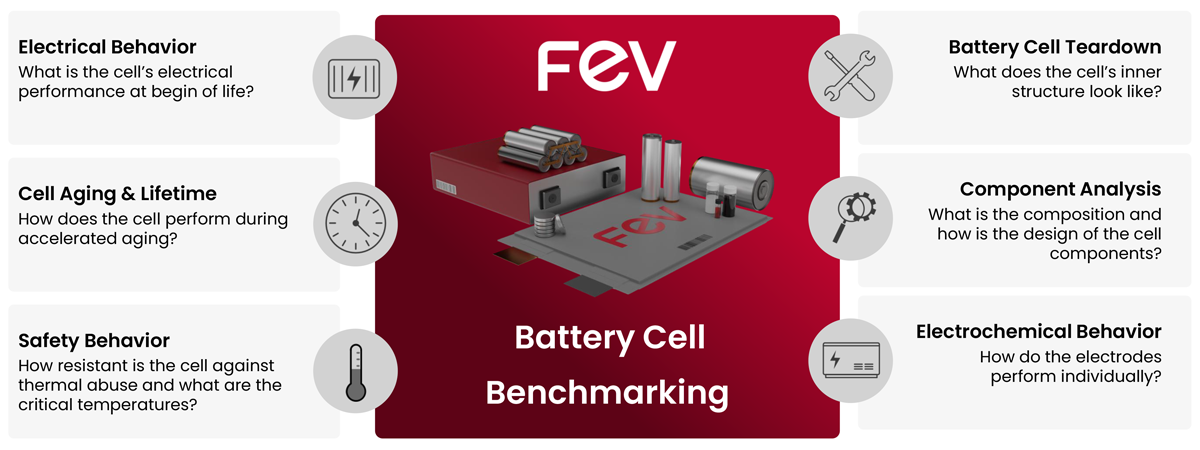
*For details on FEV’s battery cell analysis capabilities, please refer here.
Three-level analysis report
| Battery Cell Benchmark Level 3.41 - Basic |
Battery Cell Benchmark Level 3.42 - Advanced |
Battery Cell Benchmark Level 3.43 - Expert |
|
|---|---|---|---|
| Work Scope | To obtain an initial understanding of the battery cell design and its electrical performance at begin-of-life. | An advanced characterization of the used material and the cell’s resistance to thermal abuse is assessed. | To deep dive into the active materials, abuse behavior, and electrical performance. |
| Key Analysis | Cell Design
|
Cell Design
|
Cell Design
|
Available Reports
| Model | OEM | Model Year | Supplier | Battery Type | Cell Type | Level 3.41 | Level 3.42 | Level 3.43 |
|---|---|---|---|---|---|---|---|---|
| IONIQ 5 | Hyundai | 2021 | SKI | NMC | Pouch | ✔ | On Demand | On Demand |
| Dolphin | BYD | 2022 | BYD | LFP | Blade | On Demand | On Demand | On Demand |
| Model Y | Tesla | 2023 | LG | NMC | Cylindrical | ✔ | On Demand | On Demand |
| E10X | JAC | 2023 | HiNa | Na-ion | Cylindrical | ✔ | ✔ | On Demand |
| ET7 (next generation) |
NIO | 2024 | WeLion | NMC-Sem-Solid | Pouch | ✔ | ✔ | ✔ |
| SQ6 e-tron | Audi | 2025 | CATL | NMC | Prismatic | ✔ | ✔ | ✔ |
| G9 | Xpeng | 2025 | CALB | LFP | Prismatic | Coming Soon | On Demand | On Demand |
✓ :
Available now. Delivery time is 1–2 weeks.
Available now. Delivery time is 1–2 weeks.
On Demand : Analysis and report preparation will begin after receipt of the order.
The delivery time is 2 months for Level 3.41, and 3 months for Levels 3.42 and 3.43.
The delivery time is 2 months for Level 3.41, and 3 months for Levels 3.42 and 3.43.
Report Details
Battery Cell Benchmark Level 3.41 - Basic
Battery Cell Design Study
- Cell opening and teardown in an argon-filled glovebox
- Detailed photo documentation
- Weighing of components with precision scale
- Extraction of electrolyte if possible
- Measurement of main dimensions
- Creation of component-level mass and volume balances
- Preparation of material samples for subsequent analyses, e.g., cutting of material samples, washing in anhydrous DMC, and drying under vacuum.
- Electron microscopy imaging (SEM) of the electrodes and the separator with spectroscopic elemental analysis (EDS) to obtain high-level material composition and morphology insights on key components
Electrical Behavior – Begin of Life
- Electrical connection (welding/jigs) of cell and measurement of OCV curves at 25 °C
- Rate performance tests and internal resistance mappings between 0 °C and 50 °C with adequate current based on insights from battery load profile
- Data analysis and derivation of KPI like energy density, DCIR, etc.
Battery Cell Benchmark Level 3.42 - Advanced
Battery Cell Design Study
- High-detail CT scan of the cell including data analysis and expert judgement on relevant features.
- Physical and chemical analytical techniques are employed to elucidate the composition and structure of the materials as well as the electrode structures found within the battery cell of interest. The planned methods are:
- Scanning electron microscopy (SEM)
- Focused ion-beam milling (FIB)
- Energy-dispersive x-ray spectroscopy (EDS)
- Mercury intrusion porosimetry (MIP)
- Inductively-coupled plasma optical emission spectrometry (ICP-OES)
- Differential scanning calorimetry (DSC)
- Thermogravimetrical analysis (TGA)
- Fourier-transform infrared spectroscopy (FTIR)
- X-ray diffraction (XRD)
- Gas chromatography with flame ionization detection (GC-FID)
- Ion chromatography (IC),
- Acid-base titration (ABT),
- Karl-Fischer titration (KFT)
- These methods shall be used to characterize the cell components in the following manner:
- Anode electrode: FIB, MIP, ICP-OES, TGA, XRD
- Cathode electrode: FIB, MIP, ICP-OES, TGA, XRD
- Separator membrane: FIB, MIP, ICP-OES, DSC, TGA, FTIR, XRD
- Electrolyte: GC-MS, IC, ICP-OES, ABT, KFT
- Cell housing: SEM-EDS in cross-section
- Evaluation description: FEV will assess, evaluate and compile the analysis results and will holistically derive compositional and structural insights
- Determination of the porosities of the electrodes and separator
Battery Cell Design Study - Abuse Behavior
- Test setup including photo and dimensional documentation, ACIR (1kHz), cell weight and design and build-up of necessary test jigs
- Set-up of the cell in autoclaves with 5 type-K thermocouples and cell voltage contacting
- Heat-Wait-Seek test execution in a pressure-resistant environment according to FEV Heat-Wait-Seek test specifications in Argon atmosphere
- Following data will be recorded during the test with a sampling frequency of at least 10 Hz:
- Cell temperature
- Vent gas temperature
- Cell voltage
- Cell current
- Gas temperature in autoclave
- Pressure in autoclave
- Video recording
- Vessel temperature
- Cell outcoming inspection: photo documentation, weight
- Test report including analyses and graphs from specification
Battery Cell Benchmark Level 3.43 - Expert
Battery Cell Design Study
- The anode electrode and cathode electrode materials are extracted from the opened and torn-down battery cell as per Level 3.41.
- Half cells in coin format are fabricated in sufficient quantity for subsequent testing using the extracted electrode materials as well as standard coin cell components and fabrication equipment.
- A suitable reference electrode material, separator material and electrolyte solution are chosen depending on FEV expert judgement.
- If sufficient excess electrolyte can be extracted from the battery cell in Level 3.4.2, this electrolyte will be used.
- If sufficient excess electrolyte can be extracted from the battery cell in Level 3.4.2, this electrolyte will be used.
- Test descriptions:
- Pseudo-OCV tests for anode half cell and cathode half cell at 25 °C.
- Incremental capacity analysis tests for anode half cell and cathode half cell at 25 °C.
- C-rate tests for anode half cell and cathode half cell at 25 °C.
Battery Cell Design Study - Abuse Behavior
- Test setup including photo and dimensional documentation, ACIR (1kHz), cell weight and design and build-up of necessary test jigs for two safety tests
- Set-up of the cell for two test in autoclaves with 5 type-K thermocouples, cell voltage contacting and power cables
- Nail penetration and short circuit test execution in a pressure-resistant environment, according to FEV Battery Cell Test Benchmarking Specifications, test atmosphere: Argon
- Following data will be recorded during the test with a sampling frequency of at least 10 Hz:
- Cell temperature
- Vent gas temperature,
- Cell voltage
- Cell current
- Gas temperature in autoclave
- Pressure in autoclave
- Video recording
- Vessel temperature
- Cell outcoming inspection: photo documentation, recording of weight
- Test report including analyses and graphs from specification and raw data
Electrical Behavior – Low Temperature & Aging
- Extended rate performance tests down to –20 °C
- Accelerated cyclic aging at 25 °C: 1C – 1C / 10 – 80 % SOC, 500 cycles, one cell.
- Self-discharge test at 45 °C
For further details including content and price, please contact:
MarkLines Co., Ltd., Consulting Services Department
Person in charge: Mr. Usuba
TEL:(03) 4241-3906
e-mail:benchmarkdata@marklines.com
 Japan
Japan +81-3-4241-3907

 USA
USA Mexico
 Germany
 China (Shanghai)
 Thailand
 India
India
 free for 1 week
 Online Demo