




 login
login








Emitec’s Next Chapter: From Metallic Catalyst Substrates to Integrated Emissions System
-

-
 Exclusive Interview
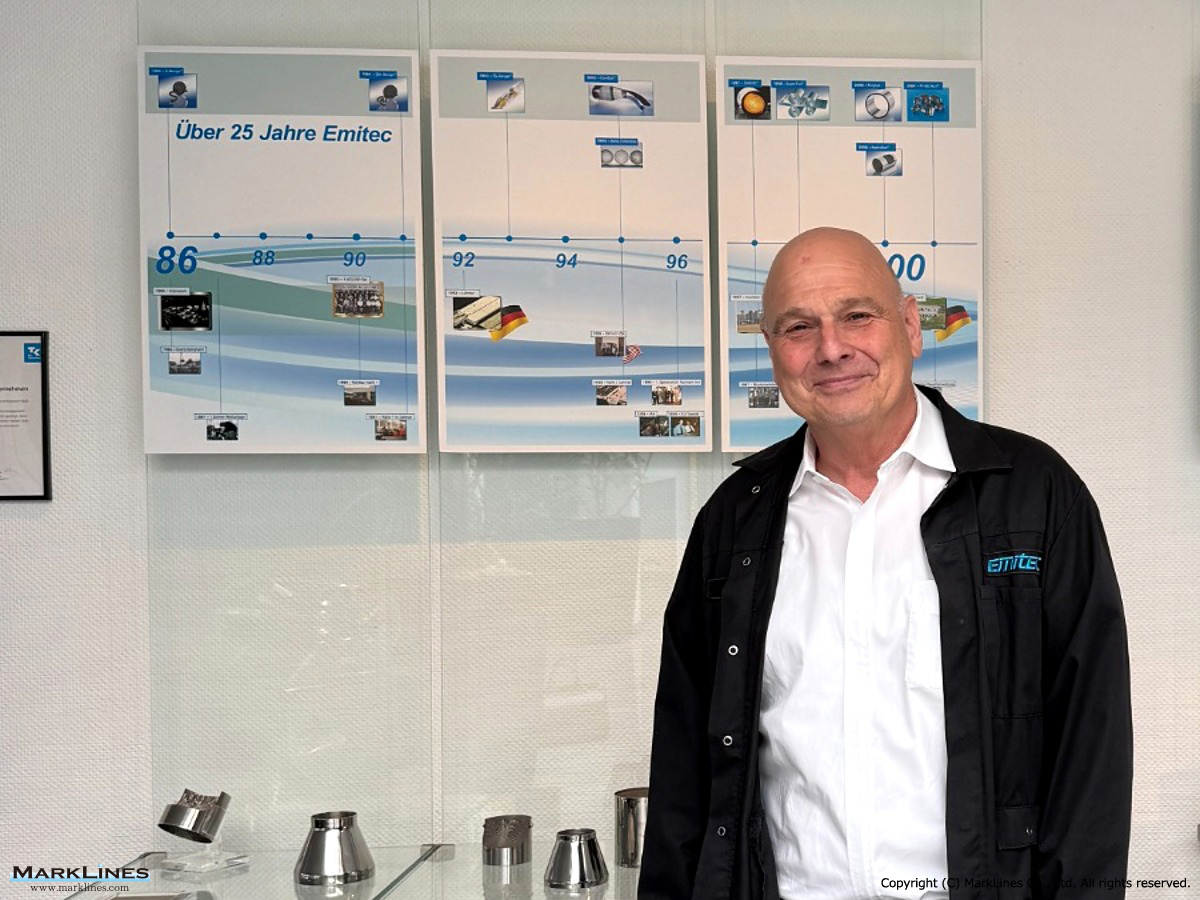
Emitec Technologies GmbH
Mr. Rolf Brück, Managing Director
Table of Contents
-
 Global Emissions Legislation and Competitiveness
-
Electrically Heated Catalysts
-
Hybridization and Exhaust Aftertreatment
-
Lean-Burn Hybrid Engines
-
Alternative Fuels
-
Metallic Versus Ceramic Substrates
-
Transformation into a Systems Supplier
-
Expansion Beyond Automotive
-
International Growth Markets
-
Strategic Realignment Following the Spin-Off
-
The Future of Exhaust Aftertreatment Through 2035
About This Interview
The Emitec Group is one of the leading suppliers of metallic catalyst substrates for exhaust aftertreatment systems. In response to ongoing changes in the mobility and energy sectors, the company is expanding into new application areas, including stationary power generation, industrial energy technologies, fuel-cell and hydrogen applications, and other sustainability-focused technologies.
In early September, MarkLines Europe GmbH visited the company's headquarters in Lohmar, Germany. During the conversation, Managing Director Rolf Brück shared his views on the future of exhaust aftertreatment, the role of hybrid powertrains and alternative fuels, international growth opportunities, and the company's strategic development.
This exclusive interview is for paid members only.
If you register as a free member, you can read the rest of this article for a limited time.
In addition, you can also enjoy the following content for free:


Question List
-
About This Interview
-
Q1Emissions regulations are increasingly diverging across global markets. What impact does this have on powertrain and exhaust aftertreatment development, and on Europe's competitiveness as an industrial and engineering location?
-
Q2What role do electrically heated catalytic converters play today, what specific advantages do they offer, and where do you see the greatest market potential for the future?
-
Q3As the transition to electrification accelerates, hybrid powertrains are becoming increasingly important as a bridge technology. How does the growing adoption of hybrid technology affect engine design, thermal management, and exhaust aftertreatment, and what advantages does it offer in terms of emissions reduction and efficiency?
-
Q4As car manufacturers aim for greater efficiency in future hybrid powertrains, gasoline engines operating on a lean mixture are once again coming to the fore. Do you consider modern concepts for lean-burn operation to be both technically feasible and economically viable, and what role does hybridization play in making these technologies suitable for practical application?
-
Q5Alternative fuels such as HVO and synthetic e-fuels are increasingly viewed as a complementary path to decarbonization, particularly in sectors where full electrification remains a challenge. What opportunities do these fuels offer from the perspective of engine technology and exhaust aftertreatment, and what role do you think they will play in the mobility landscape of the future?
-
Q6OEMs and suppliers are currently under considerable pressure to reduce costs while increasing efficiency. In this challenging environment, where do metallic catalyst substrates offer sufficient technical and system-related advantages to justify their higher component costs, and which applications offer the greatest potential?
-
Q7At this year’s Vienna Symposium, it became clear that Emitec is broadening its scope beyond its traditional product portfolio. How has the company’s role evolved in recent years, and what competencies are proving critical for future growth?
-
Q8As the automotive industry undergoes profound transformation, where do you see the most promising growth opportunities for Emitec beyond traditional markets, and what factors make these areas particularly attractive?
-
Q9Where do you see the greatest growth opportunities for Emitec in the coming years?
-
Q10Since separating from Continental and Vitesco, Emitec has entered a new chapter as an independent company. How has this transition changed the way you make strategic decisions, and what priorities are shaping the company's future development?
-
Q11Which developments will have the greatest impact on exhaust aftertreatment through 2035?
-
Editor's Note
 Japan
Japan +81-3-4241-3907

 USA
USA Mexico
 Germany
 China (Shanghai)
 Thailand
 India
India
 free for 1 week
 Online Demo